When the Path Exists: Inside the JAMP Scholar Experience
How mentorship, structure, and early support are shaping future physicians across
Texas
For many students, the dream of becoming a physician does not fade because of a lack
of talent or motivation. It often fades under the weight of financial strain, uncertainty,
and limited access to guidance at critical moments along the path.
For students like David Tedross, that moment came while preparing for the MCAT as
a full-time student balancing work and coursework, without clear direction on how
to structure a study plan or access preparation resources. For Lauren Jones, the challenge
began much earlier—growing up in a single-parent household while helping care for
siblings during her brother’s battle with stage IV brain cancer. Others describe the
experience of being the first in their family to pursue medicine, navigating a complex
process without a clear roadmap.
These moments—often unseen—are where Texas risks losing future physicians.
“I was a full-time student working a job and had no idea where to even begin preparing
for the MCAT… most importantly, I had no one to guide me through it.” —JAMP Scholar
The Joint Admission Medical Program (JAMP) was created to intervene at exactly this
point.
Established by the Texas Legislature, JAMP is a statewide workforce program designed
to support talented Texas students who face financial or structural barriers to pursuing
medical education. For more than two decades, the program has paired opportunity with
accountability—providing structured support to students who demonstrate academic promise
and a commitment to serving their communities.
Support at Critical Points Along the Pathway
To understand JAMP’s impact, it is best seen through the experiences of the scholars
themselves.
Across scholar reflections, a consistent theme emerges: JAMP is not simply a collection
of resources—it is a system of guidance and support at moments when students are most
at risk of stepping away from the pathway.
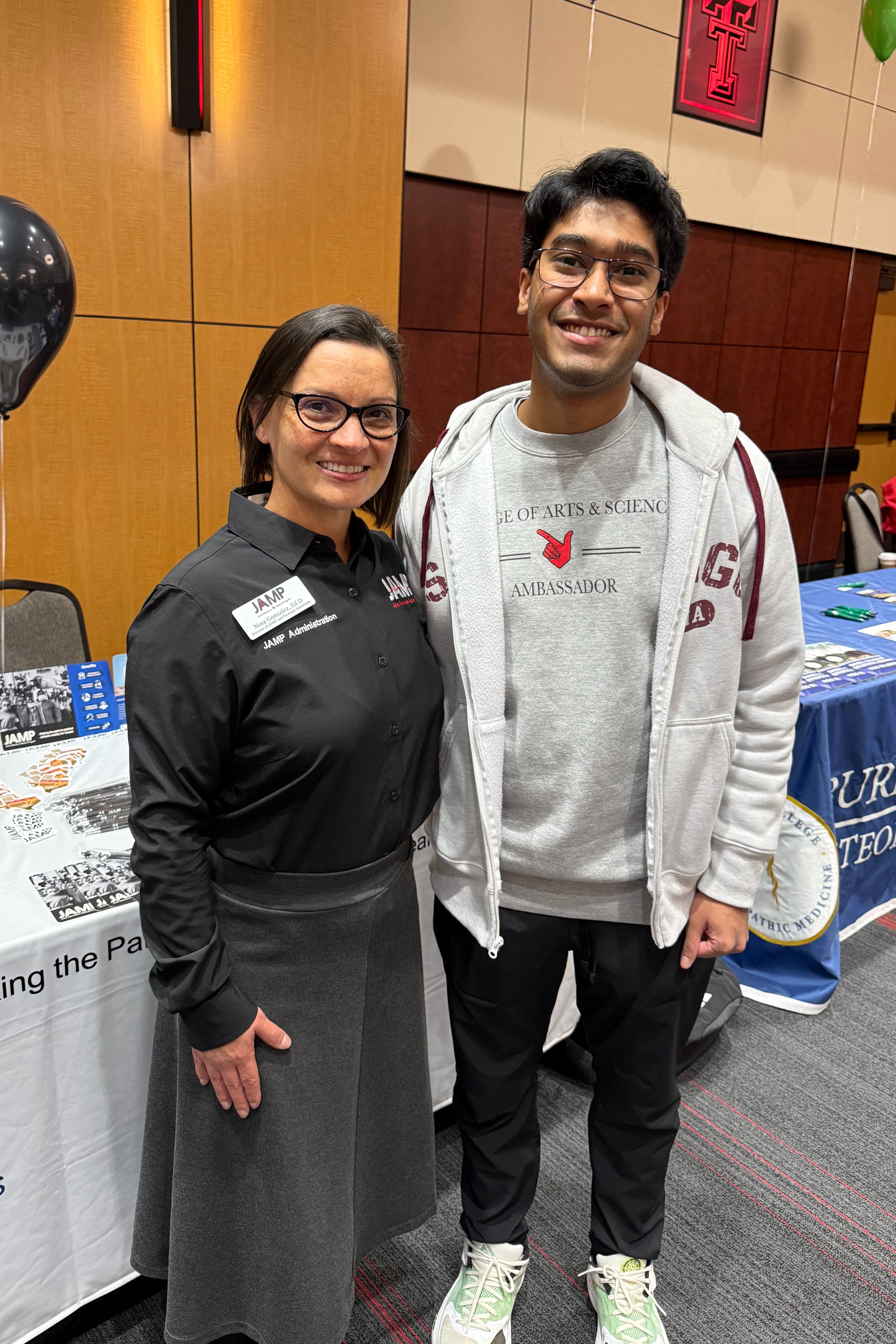 JAMP Director Nina Gonzalez beside JAMP Scholar Abid Miah
Abid Miah, a first-generation student, describes JAMP as transformative—not only for
the opportunities it provided, but for the sense of direction it created.
“JAMP gave me a sense of belonging and a clear trajectory toward medicine—it showed
me that this path was possible.”
Through mentorship, summer internships at Texas medical schools, and early exposure
to clinical environments, medicine became a clearly defined and attainable goal for
Abid. He notes that the program shaped both his academic preparation and his professional
identity, reinforcing the importance of service, integrity, and collaboration.
For Celine Luu, JAMP provided a sense of community among fellow students and mentors
navigating a shared path to medicine.
“JAMP gave me a community of peers and mentors who understood the challenges of pursuing
medicine and supported me through them.”
Through sustained faculty support and summer experiences, she developed both clinical
confidence and a commitment to mentorship—eventually supporting other students navigating
similar challenges.
That cycle of support—receiving guidance and then providing it to others—appears consistently
across scholar experiences. Nadia Syed reflects on how JAMP fostered a sense of belonging
that extended beyond financial support, connecting scholars through shared experiences,
alumni engagement, and continued involvement across cohorts.
Experiential Learning and Early Exposure
Summer internships are frequently described as pivotal moments in the JAMP experience.
Through these programs, scholars are immersed in medical school environments—attending
lectures, practicing clinical skills, studying anatomy, shadowing physicians, and
observing patient-centered care. These experiences provide early familiarity with
the expectations of medical training while reinforcing the human side of medicine.
For Brianna Jocis, these experiences strengthened clinical confidence and professional
presence.
“JAMP allowed me to focus less on navigating systems and more on developing into the
physician I hope to become.”
What Is at Stake for Texas
The impact of JAMP extends beyond individual student success.
Without access to preparation, mentorship, and structured support, many capable students
are more likely to step away from the medical pathway—not because of a lack of potential,
but because of systemic barriers that make persistence difficult. When that happens,
Texas does not only lose individual aspirations; it loses future physicians who are
committed to serving their communities.
As Dr. Nina Gonzalez, Director of JAMP and TXHES Strategic Initiatives, explains:
“JAMP exists because Texas made a deliberate choice—to invest in students who have
the talent, commitment, and heart to serve our communities, but who might otherwise
never reach medical school. When we support these scholars, we are not just changing
individual lives; we are strengthening the future physician workforce for the state
of Texas.”
That choice—supported through public investment and statewide collaboration—continues
to shape outcomes across Texas. JAMP scholars enter medical school with preparation,
professional identity, and a clear sense of purpose rooted in service.
When the Path Exists
The JAMP scholar experience reflects what is possible when structure, support, and
opportunity are intentionally aligned.
For Texas, the question is not whether this work matters—it is how to continue strengthening
and expanding pathways that ensure talented students are able to pursue and succeed
in medical education.
Learn how JAMP helps pave the way
Talk to a JAMP advisor and take your next step toward med school.
Contact JAMP
About the author: The Joint Admission Medical Program (JAMP) is a special program created by the Texas Legislature to support and encourage highly qualified, economically disadvantaged Texas resident students pursuing a medical education.